Netsuite Review Inventory Cost Accounting - What Does It Mean When an Item Is Left for Costing?
Enquire any accountant from any organization around the world – regardless of company size – which tasks they are least likely to look forrard to, and you can be certain the vast majority will say closing accounting periods!
The expert news: given the importance of period endmost activities, specialized platforms have now been developed to help accountants and controllers perform these tasks with a greater degree of confidence. Let's find out what this really ways, and how it's done in NetSuite.
- Time to read: 12 min
- Beverage pairing: A glass of Moët & Chandon to celebrate a timely and accurate month-end close
- You are a: CFO, Controller, Accounting Managing director.
- For immediate back up: if yous demand a demo, or firsthand contact us & we'll accomplish out asap
NetSuite Financial Close
If are using NetSuite every bit your ERP system, so you know that you have complete control and visibility over your core accounting processes. Managing aspects of your business organization like Acquirement Recognition, Accounts Receivable, Accounts Payable, and Bank Reconciliation is NetSuite's strong arrange – and one of the main strengths that separate information technology from the herd.
Of class, beingness a platform that is designed to be your accounting engine, and source of financial truth, NetSuite does have congenital-in functionality that will help y'all in your month-end close process – which we will walk yous through. You'll find out that in that location is usually MORE to the shut than what NetSuite allows you to do.
Equally a result, we will explore another bang-up application – FloQast, information technology makes fiscal close easy as pie – and how information technology gels with your NetSuite example.
What is so circuitous about the month-terminate closing procedure in accounting?
Earlier we dive into the menstruation closing functionality in NetSuite, let's review why the calendar month-end close is such a difficult part of the accounting cycle.
- Lack of standardization – While there are sure tasks that all companies perform every bit part of their month-end close (for instance, banking company reconciliation), there are a large number of tasks that will vary from 1 visitor to another. Almost of the time, the required tasks are specific to an individual visitor, and cognition of these tasks resides with key employees. These processes are typically non documented, making it difficult to organize the month-end shut betwixt different members of an accounting team.
- Length of fourth dimension required – A major claiming that companies face with calendar month-end close is the sheer amount of fourth dimension that it takes to shut out a month. In a written report performed by APQC , the median number of days required for month-end close was 6.iv. As a outcome, this is the fourth dimension taken away from accountants that could exist used to perform belittling and forward-looking work.
- The number of tasks – In well-nigh organizations, the month-end close usually involves a large variety of tasks that demand to be performed. This oft leads to transactions or activities being missed or overlooked, and these tin can be a real pain to revisit at a later point in time.
- Lack of automation – the procedure of closing the books is, by and large, a labour-intensive procedure. Most companies practise not have automation to shut their books, and the fiscal data needed to perform
reconciliations is scattered amongst multiple source systems or numerous excel spreadsheets! At that place is still a heavy reliance on people to coordinate and perform repetitive tasks. - Admission to data – Accessing the vital sources of data that accountants need in order to successfully close their periods can exist difficult. This is because of the presence of multiple source systems, and as well because departments and segments are scattered across multiple locations, meaning that accountants need to share documents via email, causing further delays in the close. Cloud storage solutions like Box and Dropbox certainly accept helped with this, just many organizations still haven't adopted these types of solutions.
Having looked at the above challenges, you would be hoping that the accounting software yous invest your company $$southward in would be able to help resolve some of these issues! In fairness, that assumption wouldn't be also far off the truth. Let's swoop in and find out how you tin close a calendar month in NetSuite…
The financial close solution in NetSuite
NetSuite has a Period Shut Checklist that accountants must become through in social club to close a calendar month. Below I'll take you through each of the steps in this checklist, and add together some colour to what those steps really mean in NetSuite!
Good to know: Pretty much every accounting software out there has some class of period shut functionality built into it, or at the very least volition brand it possible for accountants to perform their menstruation closing tasks.
NetSuite Fiscal Close Process
Let's start off past listing the items that can be found on the NetSuite Period Close Checklist. Something to go along in listen about this checklist is that the items need to exist completed in the order that NetSuite lists them in. While the tasks listed are applicable to all companies, most accounting teams, from a business process standpoint, will non necessarily complete them in the order that NetSuite lists them in.
Autonomously from the first iii tasks, the residue of the tasks have buttons labelled "Marking Task Complete" to prevent duplicating a job. The post-obit three areas must exist locked earlier the remainder of the list can be addressed:
| Task | Check |
| Lock A/R | ✅ |
| Lock A/P | ✅ |
| Lock All | ✅ |
Once those tasks are locked, the tasks below must be addressed in social club to be able to close the menses. Each of these tasks has a button called "Mark Task Consummate" , which will point to the residual of the accounting team that this activity has been completed, and allows you to so move on to the next item in the list.
| Task | Cheque |
| ✅ ("Marking Chore Consummate" Choice) |
| 2. Review Negative Inventory | ✅ ("Mark Job Complete" Option) |
| three. Review Inventory Cost Bookkeeping | ✅ ("Mark Task Complete" Choice) |
| 4. Review Inventory Action | ✅ ("Mark Task Complete" Option) |
| v. Create Intercompany Adjustments | ✅ ("Mark Task Complete" Option) |
| half dozen. Revalue Open Strange Currency Balances | ✅ ("Marker Task Complete" Choice) |
| 7. Calculate Consolidated Substitution Rates | ✅ ("Marker Task Complete" Selection) |
| eight. Eliminate Intercompany Transactions | ✅ ("Marking Task Consummate" Option) |
| ix. Close (Period) | ✅ ("Marker Task Complete" Selection) |
Here is a visual of what this actually looks like in NetSuite
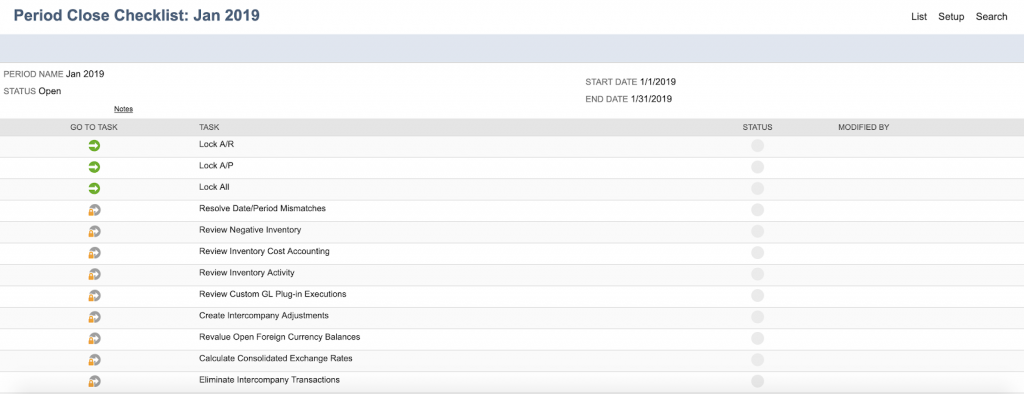
At present allow's go through the steps to get a better agreement of what they stand for we'll also outline ways in which your accounting teams can get around the gild that they are listed in, every bit well as some really cool tips on how to speed up your close in NetSuite for each of the items in the checklist
1. Lock A/R
Near companies prefer to determine their sales and revenue numbers equally soon every bit the period ends. Hither'south why:
- Information technology ensures that the invoices are in customers' hands to exist paid, and provides a view of how constructive the selling process is.
- It too allows for a review to ensure all appropriate revenue has been recognized.
One time the sales and revenue numbers for the month have been finalized, companies volition close the Accounts Receivable part to preclude any sales or revenue amounts from beingness inappropriately recorded in the period being closed.
Pro Tips:
- A lthough Sales Orders or Invoices tin be dated in airtight periods, (if the option is enabled), they will be posted to the first available open catamenia.
- Custome r receipts volition need to be upwards to engagement in order to lock A/R. If receipts are non up to engagement, then A/R will need to exist opened at a later on date to arrange this.
- Where services are performed and not invoiced, such as milestone billing projects, companies can mail journal entries to accrue revenue and post the receivable to Work-In-Procedure or Other Receivables, as the customer is non obliged to pay until invoiced. This means that the Accounts Receivable sub-ledger does not need to be opened and the sub-ledger will only contain invoiced amounts. The Journal entries accruing revenues will ultimately be reversed in the period that the actual billing occurs.
2. Lock A/P
About companies will set deadlines for vendor invoices to be submitted into A/P for processing and payment related to the prior month's activity. One time all of these vendor invoices have been entered, the A/P ledger will be closed to allow for the review of results and the processing of payments to vendors.
Typically, whatsoever cloth invoices received subsequently A/P is locked, related to the menstruation being closed, volition be accrued by journal entry and reversed in the following catamenia. These accruals are calculated past the Accounting squad based on the knowledge of the business and understanding what goods and services have been received.
Have Note: Although Buy Orders or Vendor bills can be dated in airtight periods, (if the option is enabled), they will exist posted to the first available open up flow.
3. Lock All
Now that your A/R and A/P are locked, your bookkeeping team will typically review the results and make certain that all appropriate standard entries and recurring entries accept been made in order to shut the period. The "Lock All" selection will primarily preclude any accounting staff from recording whatsoever more entries into the period being closed.
Accept Note: Retrieve the point we fabricated before about companies not typically going through the checklist in the order that it is outlined? Well, this is a very good instance of that, where some companies may not actually lock their G/L until belatedly in the shut process, as they may want to reconcile some sensitive accounts such equally cash (bank reconciliation) and intercompany accounts, prior to closing.
Unfortunately, you can't progress through the checklist until you actually "Lock All"
4. Resolve Date/Menses Mismatches
So, now that you've locked your M/Fifty, and no more transactions tin be posted in your current menstruum, you lot motility on to review any transactions that may be dated in your electric current period merely were inadvertently posted in another menses. This process needs to be done in club to ensure that transactions have non been posted to an incorrect menses.
Let's visualize this with an instance. Say yous have, an invoice that is dated July 2016, but is posted to the September 2022 period, and so it will demand to exist reviewed. In this example, if you are closing in July 2016, then the posting to September 2022 might really be incorrect. A review would need to exist done to see if the posting period needs to be adjusted.
Take Note: If you are closing September 2016, then this could be legitimate in cases where an invoice is reissued in September 2022 for an fault that occurred in July 2022 (closed period) and you don't want to restart the ageing of the invoice to the customer. If this is the case, in that location should be a credit memo offsetting the original July 2022 invoice, posted in September 2016.
Pro Tips:
- If y'all want to prevent mismatches from always occurring, NetSuite has a feature that allows you to restrict users from entering a transaction with a date that is outside the posting menstruum selected. This, of course, will reduce the amount of piece of work that will need to be washed come up month-stop!. However, earlier enabling this setting, practice keep in mind the instance we gave above under "Of import", as that might be an case of a state of affairs where you need to post to a period that is different from the transaction date.
- If you wish to review these earlier the month-end closing process, you can set upwards a saved search to review mismatches regularly in order to consummate this task well ahead of the month-end shut. This is an awesome way to reduce your fourth dimension to close!
Good news: When resolving Engagement/Period Mismatches as part of the month-end close, ane of the cool features NetSuite has is that information technology automatically brings upwards a listing of transactions that accept a mismatch, so that yous can review and address them one by one with relative ease.
v. Review Negative Inventory
If you lot are a company that carries physical inventory, and then this is a task yous will have to perform. Here, you lot are investigating why any inventory items went into a negative position at the period end and making the required adjustments.
Pro Tips:
- The negative inventory indicates that a process upshot may be. Typically, this may mean that a receipt of goods has non occurred or a shipping document to a customer has overstated what was shipped. This step is important, equally once Netsuite has an inventory item go into a negative position, any shipments of that detail will be recorded at zilch price, which will understate your cost of goods sold.
- If you would like to perform this task before the month-end closing procedure, you tin can set a saved search that brings upwards a list of items that have negative inventory throughout the month. This means you can address them periodically, allowing you lot to complete this task well ahead of the month-end, and reducing your time to close.
6. Review Inventory Cost Bookkeeping
In this step, y'all are ensuring that all appropriate costs have been picked up on inventory transactions and that the inventory costing calculations have been completed for the month. This stride may also identify scenarios where inventory transactions have been posted in the incorrect catamenia or wrong costs have been allocated. An example would exist someone miskeying a vendor invoice for $600.00 per unit vs. $6.00 per unit of measurement – I hateful, we are human after all, and mistakes similar that Do happen.
Tip: If you would similar to review these before the month-end endmost process, you lot can ready a saved search that will allow y'all to review inventory cost bookkeeping regularly in club to complete this task well ahead of the calendar month-finish close.
7. Review Inventory Activity
This process is washed to ensure that at that place are no unusual inventory fluctuations, which once more would indicate that a process issue may exist.
Here's an case – Say y'all sell an item – Widget A – and you usually keep around 100-150 units of Widget A on hand. As part of the Review Inventory Activeness process, you lot realize that yous have 1,000 units of Widget A in your on-mitt inventory when going through the report. You tin can now investigate this issue, and notice out if you lot actually exercise have i,000 units on hand. Chances are that upon receiving the inventory, the receiver has posted 1,000 units instead of 100 units!
Pro Tip: As is the case with the in a higher place processes in the Period Shut Checklist, yous can set up a saved search to review inventory activity regularly in order to consummate this chore well ahead of the month-end close.
viii. Create Intercompany Adjustments
This procedure applies specifically to companies that have more than ane legal entity they are accounting for, and that use a Parent and Subsidiaries construction. These companies will typically have intercompany accounts to record transactions that occur betwixt the legal entities. For instance, a Parent Company provides services to 1 of its subsidiaries.
In a example like this, the sale would be recorded in the Parent and the price would be recorded in Subsidiary, using intercompany accounts. The issue is that from a consolidated reporting perspective the transaction has zero value to the consolidated entity. Therefore, when closing, the revenue and cost accounts would be eliminated when consolidating at each flow's cease.
Netsuite allows for a certain time and expenses to exist allocated across subsidiaries. In order to complete these allocations, intercompany adjustment journals demand to exist candy.
In many cases, companies volition exercise journal entries during the month to ensure that the intercompany accounts stay in line. If that is the case, and so entries automatically prepared past Netsuite may not be required.
Pro Tip: This feature in Netsuite, for intercompany expenses, tin exist inverse from "Allow Auto Suit" to "Permit". This should be reviewed with the Finance team to determine if they desire Intercompany Aligning Journals to be gear up automatically.
ix. Revalue Open up Foreign Currency Balances
Whatsoever company with strange currency balances will need to revalue its current assets and liabilities to reflect the menses-end strange commutation rates, as per Generally Accepted Accounting Principles (GAAP). In many cases, the Accounts Receivable and Accounts Payable will concord foreign currency balances.This procedure will typically exist done after locking A/R and A/P. Any strange currency bank accounts would likely be revalued after the banking company accounts have been reconciled.
Take Note: This process should be done for each legal entity (subsidiary), peculiarly where the base currencies differ.
10. Summate Consolidated Exchange Rates
If yous are a Parent company with legal entities denominated in a foreign currency, (e.m. Parent in USD, Subsidiary A in GBP and Subsidiary B in AUD), you will need to consolidate your results using up-to-engagement foreign exchange rates!
Pro Tips:
- Set rates as early on as possible: Given the need to reconcile intercompany accounts with dissimilar currencies, setting these rates needs to be done early on in the period-end close process. Many companies summate and set up these rates equally soon as the menses end rate is known. The three rates used for consolidation are:
- Current: this is the charge per unit at calendar month-finish and is applied to current assets and current liabilities.
- Average: this is the boilerplate rate during the month and is applied to revenues and expenses.
- Historical: this is the charge per unit practical to long-term avails, unremarkably stock-still avails, and long-term liabilities – although long-term liabilities are typically adjusted for quarterly or annual reporting.
- If an detail is tagged with a historical rate, it volition not be updated in futurity periods. Any required adjustments will need to be done via a journal entry.
While Netsuite will calculate these rates, many companies prefer to summate these rates themselves, since the Boilerplate and Historical rates in Netsuite are calculated using actual transactions posted in the system. This may skew the rates unintentionally due to the timing of the entries.
11. Eliminate Intercompany Transactions
In situations where the intercompany transactions exercise not beginning when consolidating, eliminating entries will need to be recorded manually. A common example of this is when a Parent Company records ownership in a Subsidiary equally Investment, while the Subsidiary records the Parent'due south ownership equally Common Stock (shares).
When consolidating the results, a periodical entry would be required to eliminate the Investment and the Common Stock. Any entries of this type are usually known well ahead of time and typically booked manually.
Expert news: NetSuite tin besides be gear up to create eliminating entries, which means this task must be performed prior to the month-stop close. These entries volition be generated past NetSuite based on intercompany transactions entered throughout the menstruum where individual lines are marked equally "Eliminate" for month-end.
Pro Tips:
- This is the only process in the month-end close that cannot be performed out of sequence.
- That being said, you tin preliminarily close all the prior steps to run this process and then reopen the prior tasks to perform them, if need exist.
12. Close Flow
Almost there! Now that you've reviewed all the necessary processes on the checklist, the final step is to close the accounting flow. This will preclude any other transactions from being posted to this menstruation.
If you are a company that has multiple operating subsidiaries, and one subsidiary is delayed in closing, you could encounter bug if entries are posted after reports take been issued to direction. It is important to maintain a consequent close schedule to prevent transactions from being posted to the wrong period, which volition result in inaccurate reporting.
Take Note:
- If you are using the Multi-Book Accounting feature in NetSuite OneWorld, then this process can be washed for each Bookkeeping Book separately, or you tin choose to shut the period for all accounting books at the aforementioned time by selecting, "Accounting Book = All".
- This can also exist done for all subsidiaries at 1 time, or each subsidiary separately.
- The to a higher place decisions should, of course, be reviewed carefully with the Finance squad to determine whether they want centralized control of the process or for each legal entity to be accountable. It typically depends on the corporate construction and the power of staff to follow the schedule.
13. Allow Non-Thou/L Changes
To be clear, this is actually not a specific step in the Period Close Checklist, BUT information technology is a very useful checkbox that you tin prepare when closing the period. You can modify sure Non-Chiliad/Fifty related fields, (e.g. PO numbers, Addresses), by putting a checkmark in the box in the Base Catamenia screen. Any user with permission to make Non-Thou/L Changes volition then be able to make those types of changes to records in a closed period. This is particularly useful to correct notations on Invoices or revise descriptions instead of having to credit and reissue invoices.
Pro Tip: If you finish up using this feature, then, please exist aware that if you check this box for a given base of operations period, then each time you go into a specific period to unlock a task, this flag may reset to disallow Non-Thousand/50 changes, (i.due east. setting removed). Then, exist Certain to check that box again later locking the task!
CONGRATULATIONS! Y'all have just successfully completed your first-calendar month terminate close in NetSuite
Pro Tip: Here'southward how you can access the Period Shut Checklist in your NetSuite account:
- On your NetSuite habitation screen, navigate to Setup > Bookkeeping > Manage Chiliad/L > Manage Accounting Periods
- Then, select the accounting menses that y'all would like to close, and permit the fun brainstorm
Month End Close Checklist
Now, we mentioned throughout this post that the sequence in which the NetSuite Period Close Checklist lists the required tasks is not very practical from a business procedure standpoint. What nosotros've done in the below table is change their society, based on our experience, and straight you on how you can go around that order in NetSuite every bit an alternative.
All only "Lock A/R", "Lock A/P" and "Lock All" have the "Mark as Job Complete" Option that tin can be used, if the task has been completed.
| Step | Process | Bank check |
| Calculate Consolidated Substitution Rates | List > Accounting > Consolidated Exchange Rates | |
| Create Intercompany Adjustments | Transactions > Financial > Create Intercompany Adjustments | |
| Lock A/R | A/R must exist locked from the Menstruum Close Checklist | |
| Lock A/P | A/P must exist locked from the Menstruum Close Checklist | |
| Calculate Consolidated Exchange Rates Revalue Open up Foreign Currency Balances | Transactions > Financial > Revalue Open Currency Balances | |
| Resolve Appointment/Period Mismatches | Create a Saved Search | |
| Review Negative Inventory | Create a Saved Search | |
| Review Inventory Cost Bookkeeping | Create a Saved Search | |
| Review Inventory Activeness | Create a Saved Search | |
| Lock All | All (G/Fifty) must be locked from the Period Close Checklist | |
| Eliminate Intercompany Transactions | If this has been completed prior "Marking as Task Complete" Choice, when locking the period | |
| Close Period | Catamenia must be airtight from the Menses Close Checklist | |
| Cheque "Permit NON-G/L Changes", | If this functionality is needed, the checkbox can be establish on the "Close Period" screen. Setup > Accounting > Manage G/L > Manage Accounting Periods > Close > Let Not-1000/L Changes |
Is the NetSuite Period Close Checklist Plenty?
- NetSuite is solid at covering the nuts. This may be plenty for a business that has straightforward processes or is pocket-sized enough that the close tin be easily managed by a few people. Still, about businesses (depending on the complication of their processes) volition typically have to practise a lot more to successfully go through a month-end shut – on time, AND satisfy inspect requirements! This means that Mode more tasks will have to exist coordinated and managed than those that are outlined in the NetSuite Flow Shut Checklist.
- It will diagnose problems & figure out that something went incorrect in your concern process over the last month. For example, checking whether or non you have any items that are reporting negative inventory. Merely, what information technology doesn't do is tell you what actions or steps you lot need to do in order to fix that.
- The period close checklist isn't all inclusive equally there are many more activities the accounting team needs to accept on, the question and so becomes, how and where practise yous runway these additional tasks? The majority of companies will do this in excel spreadsheets. This, of class, adds much more complexity to an already stressful procedure.
- Apply FloQast..immediately – NetSuite has suite apps that add tremendous value to your business organization processes, for the period close, FloQast is definitely the peak close direction software.
Source: https://trajectoryinc.com/blog/month-end-close-process-in-netsuite/
0 Response to "Netsuite Review Inventory Cost Accounting - What Does It Mean When an Item Is Left for Costing?"
Post a Comment